


In partnership with

Hey there friends, and happy election day! You’re getting this email approximately 10 minutes away from the first polling place closures today! I know the conventional wisdom is to avoid screens for the day, but I wanted to write a quick guide for those of us who plan on spending our evenings refreshing Twitter and watching Steve Kornacki paint his map. So, let’s just jump into it!
What we know
Genuinely, it’s not a clear picture right now. The polling is neck and neck.
BUT…
That doesn’t necessarily mean the election is going to be close. Polls often have a margin of error in the 3-5% range, meaning that the 50/50 in a given state could end up being 55/45 That’s a 10 percentage point difference!
Because of this, we’re a standard polling error away from a blowout win by either side.
So go into tonight expecting legitimately any single scenario to happen. Gun to my head, I think I’d rather be Kamala Harris right now, but I’m also acknowledging my biases in my reading of the polls and early voting numbers. Really, anything can happen.
Savvy Investors Know Where to Get Their News—Do You?

Here’s the truth: there is no magic formula when it comes to building wealth.
Much of the mainstream financial media is designed to drive traffic, not good decision-making. Whether it’s disingenuous headlines or relentless scare tactics used to generate clicks, modern business news was not built to serve individual investors.
Luckily, we have The Daily Upside. Created by Wall Street insiders and bankers, this fresh, insightful newsletter delivers valuable insights that go beyond the headlines.
And the best part? It’s completely free. Join 1M+ readers and subscribe today.
How to track what’s happening
The early signals
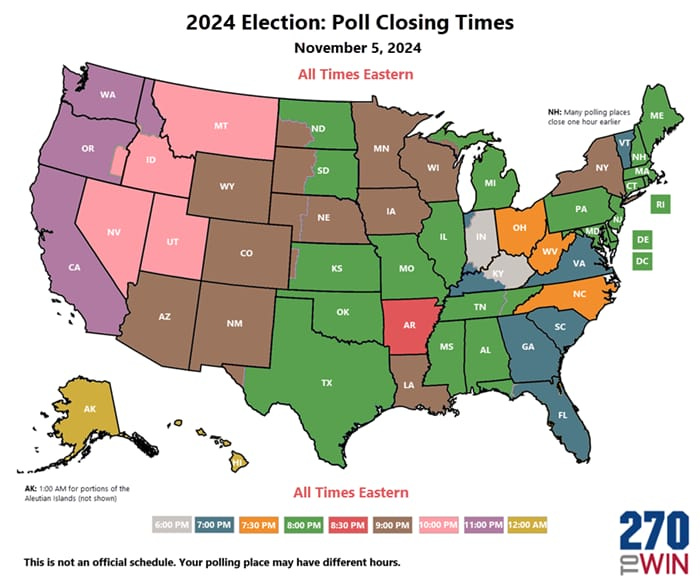
Let’s take a look at when the most important swing states close their polls. This is usually also the time that the state elections office reports its first batches of votes. These are usually the early and absentee votes, as precincts need to report their election day totals to their county elections offices before they can be added to the count. So, take a look at this list for a good timeline of what elections watchers will start looking for at what times (all times EST).
6:00 PM — Indiana, Kentucky
Neither of these states are very important electorally for either candidate—Trump is expected to win these both pretty handily. However, these are going to be our first look at voter turnout, and allow us to compare the results we see against polling results. Don’t extrapolate too much here, but these states will be our earliest opportunity to put our thumbs in the wind and check the direction.
7:00 PM — Georgia, Florida
These will be our earliest real looks at the demographic breakdowns of the electorate. Georgia is a swing state which is going to be pretty important for either candidate. Florida, on the other hand, is almost certainly going to go to Trump. However, we can use both of these states to start getting some insight specifically into how heavily Black and Latino communities are voting. Georgia also allows its elections officials to count mail-in ballots as they come in, so it will likely be one of the earlier swing states to report most of its votes.
7:30 PM — North Carolina
North Carolina polls close just about half an hour later. While a bit more Trump-friendly than Georgia and many other swing states, but it could end up swinging toward Harris depending on which voters turn out. The First Congressional District of North Carolina (40% Black, 40% white) is also expected to be a bellwether for how the Black vote is going to turn out. Republican Gubernatorial candidate Mark Robinson is also enormously unpopular, which can lend some insight on the impact of an unpopular statewide candidate on up-ticket performance.
8:00 PM — Pennsylvania, Michigan
Pennsylvania is one of, if not the most important state to either candidate’s electoral prospects. Michigan is also much more competitive than it has been in recent election cycles. They are also going to be very important in helping to validate extrapolations from Florida, Georgia, and North Carolina regarding the Black and Latino votes. The earliest point that I think anyone can start to make real predictions with some level of confidence is when a decent percentage of these votes get counted. No guarantee that anything will be knowable, but we’ll probably have a decent understanding of who’s leading.
The second round
9:00 PM — Wisconsin, Iowa, Minnesota
Wisconsin and Minnesota are both key swing states this cycle. Iowa wasn’t expected to be until famously accurate pollster Ann Selzer released a poll showing Harris up by 3 points. These states will all be helpful in understanding the urban/rural divide and education divides among white voters. Iowa’s recent implementation of an abortion ban can also give some early indicators about the impact of abortion of suburban female voter turnout—which will be critical in Arizona.
10:00 PM — Nevada
The last of the swing states to report, Nevada could be overlooked if one candidate is clearly ahead, or it could be the deciding electorate if things stay close. In 2020, Nevada was one of the slowest reporting states and part of the reason that it took us nearly a week to find out who won. However, Nevada election officials have been allowed to count ballots as they come in this year, which I’m hoping will reduce the odds of us having to wait.
The laggards
Wisconsin & Pennsylvania VBM
Neither of these states allow their elected officials to start counting mail-in votes until the morning of the election. Because of this, expect most—if not all—VBM ballots to be reported late here. These states and Arizona (which we’ll talk about next) are going to be the three most likely chokepoints if the election is close. If you go to bed tonight not knowing who is probably going to be the next President, you have these three electorates to thank!
Arizona
Voting by mail is massive in Arizona: in 2020, nearly 90% of voters cast their ballots early, with the majority of those votes being by mail. The large retiree communities and significant swatches of rural voters means VBM voting is very common. Unlike Wisconsin and Pennsylvania, Arizona election officials are able to tabulate the votes as they come in. But the sheer quantity of mail-in ballots may delay the state being called for either candidate if it ends up being close. Arizona does have abortion on the ballot and a seriously unpopular Republican senate candidate in Kari Lake, which may end up making this an easy grab for Democrats. But it may end up coming down to those absentee votes.
The conversations to expect
Regardless of who wins, expect heartbreak and misinformation online tonight. While cities board up for potential riots in the event that Trump wins again, right-wing pundits are already spreading fear and speculation about the election being rigged.
This will continue regardless of who wins.
Our cultural problems are not going to be solved either way.
We will need to continue strive for compassion and understanding, and be a better influence than those who infuriate us. As I well know, this is easier said than done.
But hopefully, in following the election tonight, you can use the tips included in this article to sniff out the BS, keep a level head, and gain a better understanding of how the ballot-counting unfolds.
How was this post?
Let me know why in the comments!