


There’s a certain kind of critic who earns the right to a strong claim. And there’s the other kind.
I do not normally write about physics, or acoustics, or epidemiology. I am writing about them right now, however, because a piece has been circulating in my corner of the internet that illustrates a pattern I do write about: the pattern of confident debunking that is itself badly wrong, and that gets social traction precisely because it sounds measured.
The specific fight is about data centers; more specifically about the sounds that they make. The more general question, however, is how a piece of writing can be so fluent, so credentialed-sounding, and still so confidently wrong, and what that failure mode tells us about the broader market for debunking.
This failure mode has grown in the last few years. The capital-R Rationalist-adjacent takedown. The Substack exposé of someone else’s Substack exposé. The piece that wins by tone rather than evidence, and that counts on the reader not checking the citations. It is a genre, and it has conventions, and in this case Andy Masley has followed them faithfully. You might be concerned that I am doing the same here. No need to worry; unlike Masley, I do not pretend to be a high priest of all things data center.
What’s this argument even about?
Benn Jordan is a musician and YouTuber who has spent years recording sounds outside the human hearing range. He recently released a widely-viewed video arguing that data centers emit infrasound at levels that correlate with health complaints from nearby residents. The video has real problems – misrepresented citations, overreaching mechanistic claims, a self-run experiment with serious design flaws. It also contains real empirical work and a reasonable core question. It’s a fascinating video that, if taken with a grain of salt, can be quite informative about the potential problems data centers may pose for local communities and how we might better mitigate against them.
Andy Masley runs a Substack covering AI and the environment. He is a former physics teacher. He sometimes does decent work on the hysteria around AI land and water use, even at one point having forced the author Karen Hao to correct her own book citing water consumption levels 1000x higher than reality. Ostensibly riding high on that achievement, he has now published a 10,000-word takedown of Jordan arguing that infrasound harms from data centers are “fake.” The piece has been getting circulated around techno-optimist circles (where I often find myself) as a definitive debunking.
But unlike his critique of Hao’s work, his criticism of Jordan’s video (and his subsequent online behavior) is seriously lacking to the point of undermining the rest of his work. Jordan has overreached. Masley has overreached further, in the opposite direction, while positioning himself as the corrective. This essay is about the second overreach, because the first is getting plenty of attention already and the second is not.
I am not here to defend Jordan’s video. Several of Masley’s specific criticisms of it are correct, and I will say so plainly. Jordan is an anarchist, and can be a bit of a crank at that. Sometimes he does incredible journalism (see: this takedown of Flock security cameras), and other times his political zeal gets the better of him. The problem is that Masley does not stop at the defensible criticisms. He keeps going, past the evidence, past his expertise, past the point where a good faith critique would hedge, before finally arriving at the audacious (and unscientific) title “Contra Benn Jordan, data center (and all) sub-audible infrasound issues are fake.”
Before we go any further, I want to make one thing absolutely, positively clear: Andy Masley is claiming that all alleged issues ascribed to sub-audible infrasound are fake. He expands the claim in a followup tweet after Jordan responded less than pleasantly:
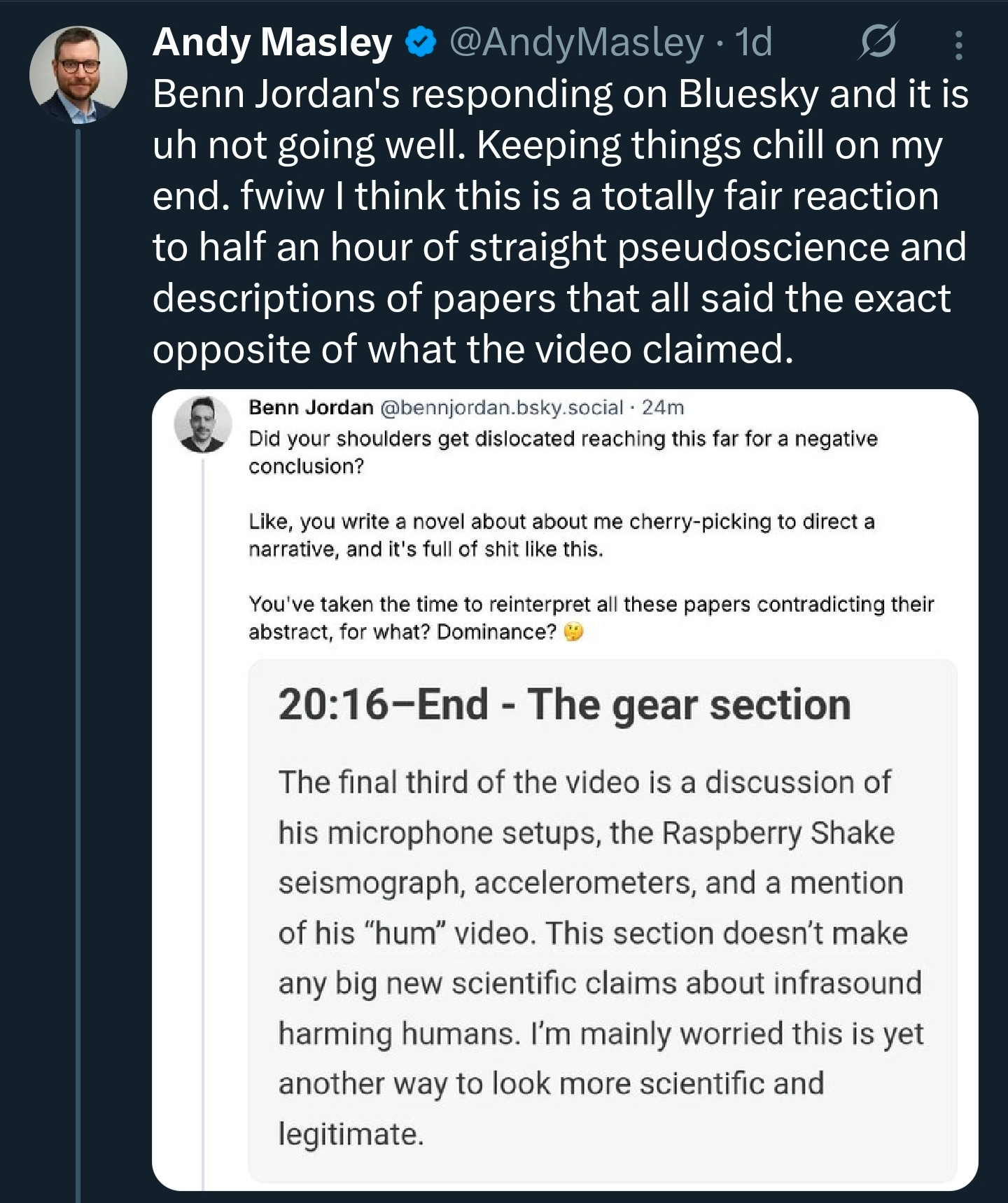
Masley’s claim is not that Jordan’s interpretation is strained, or that his evidence is weak, or that his conclusions outrun his data. His claim is that Jordan’s sources say the exact opposite of what Jordan says they do. This is a very strong claim. It is also one you can check.
What follows is technical in places, but not difficult. The concepts involved can be explained in a few paragraphs each, and they have to be, because Masley’s argument depends on the reader not having them. Once you have them, the argument falls apart on its own.
Before we get going, let’s first define infrasound as a phenomenon. After all, it is the central focus of this argument. Infrasound is defined as “Sound at frequencies less than 20 Hz,” given that 20Hz is the approximate lower limit of the range of human hearing.
Now, let us start with the single most consequential error in the piece – one that recurs throughout and that a physics teacher, of all people, should not have made.
He does not seem to know what a decibel is measuring
Masley has gone on a full-frontal assault against Jordan, tweeting and Bluesky-ing (what is the verb for that, anyway?) for a few days straight now. In doing so, he has revealed that he does not understand the difference between what a microphone measures and what a human hears; a confusion on which he has built a significant portion of his argument.
When we talk about sound levels in decibels, the number is meaningless without knowing decibels of what. High pitched sounds and low pitched sounds are audible at different decibel levels. To address this issue, different weighting scales have been developed over time. When discussing whether a sound was audible, perceptible, or harmful, we need to know what weighting scale was applied to the measurement. The three relevant scales at play here are:
dBA (A-weighting): designed to approximate how the human ear responds to audible sound. It severely filters out low-frequency content. A 10 Hz signal gets attenuated by roughly 70 dB under A-weighting.
dBC (C-weighting): applies much less filtering at low frequencies. Better for measuring loud, low-end sounds.
dBG (G-weighting): specifically designed for infrasound, weighted to reflect sensitivity in the 1–20 Hz range where infrasound lives.
“60 dB” is a meaningless number without knowing the scale, the way “60 degrees” is meaningless without knowing Celsius or Fahrenheit.
Masley discusses Jordan’s citation of a Polish farm paper that measured exposure to infrasound from farm machinery during an 8-hour workday. The paper identified that half of the measured infrasound sources on the farm reached average G-weighted levels at or above the 102 dBG occupational guidance for a workday.
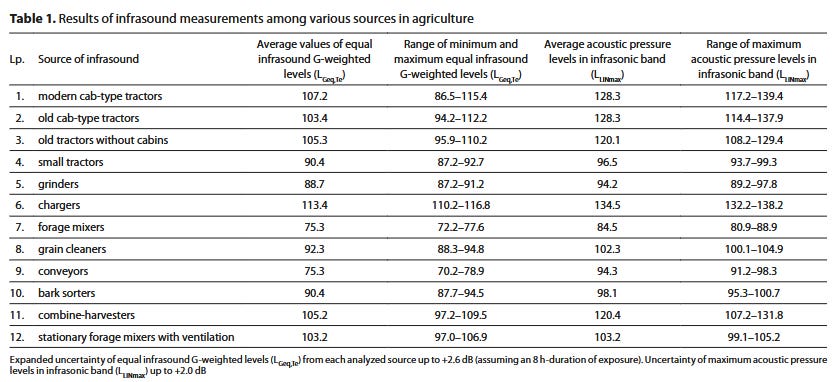
That’s fine, Masley explains:
Data center and wind turbine infrasound at residential distances is typically in the 50 to 75 dBG range. That might sound like a small gap, but remember that decibels are logarithmic. Every 10 dB increase represents a 10x increase in sound intensity, and every 20 dB increase represents a 100x increase.
So this is telling us that even the loudest data centers near people’s homes are several hundred to over a hundred thousand times quieter than what the occupational standard the Bilski paper is using considers safe for a full 8-hour workday of direct exposure. The paper Jordan is flashing as evidence of infrasound harm is, if you actually read it, implying that our regular daily infrasound exposure could be multiplied by 1000 and still be totally safe.
Except there are four glaring issues with this statement:
Masley claims that “Every 10dB increase represents a 10x increase in sound intensity.” This is technically true, but it is the wrong quantity for the argument he is making. Intensity describes the power per unit area carried by the sound wave through the air. What matters for the biological mechanisms Jordan is describing (pressure on the eardrum, stimulation of vestibular structures, outer hair cell response) is not intensity but pressure. And while a 10dB increase represents a 10× increase in intensity, it represents only a ~3.16× increase in pressure. Reporting the intensity ratio rather than the pressure ratio inflates the apparent safety margin by roughly a factor of 300. By the quantity that actually maps to the effects Jordan is proposing, the gap between residential data center levels and occupational exposure limits is one to two orders of magnitude in pressure, not the five orders of magnitude that Masley’s framing implies. It matters significantly less what the power of sound is at the source here than the pressure change at the point of “impact” for the listener.
Masley conveniently only cited the broad occupational guidance for 8-hour workdays while omitting the exposure limit for workplaces requiring maintained mental concentration, which is a much lower 86dB. OSHA also identifies 85dBA as the occupational limit for sound exposure over an 8-hour period. Using this number for comparison, data centers are only ~4x quieter than occupational standards allow for certain roles.
These figures are for eight hours of exposure. The dose makes the poison. It’s quite absurd to say “this is under the threshold for eight hours of exposure, so it’s surely under the threshold for 24/7 exposure!”
The study notes that the impacts of infrasound may pose greater risk to “pregnant women and adolescents,” possibly justifying an even lower rating of dBG.
Masley handwaves away this last point, but studies have shown that there is a potential link between chronic sound exposure during pregnancy and negative health outcomes. The CDC even tells pregnant women:
Avoid low frequency sounds (noises you feel as a rumble or vibration). Low-frequency noise travels through your body more easily than high-frequency noise. Low-frequency noise can cause changes that could affect your developing baby.
Masley’s criticism of this study seems to solely focus on the auditory impact of occupational exposure, without even thinking about how sound works. Infrasound is not a potential threat because of a more intense volume; it is a potential threat because of the pressure changes it causes. For all of his grandstanding over Jordan’s “pseudoscience,” Masley seems to think that decibels only measure sound.
Before I go any further, let me ask you something: does this seem like it says the exact opposite of what Jordan is claiming? There is room for good faith disagreement on the merits of the study, on interpretations of the findings, etc. But personally, I don’t believe that anyone acting in good faith can read the above research as being diametrically oppositional to Jordan’s claims like Masley says it is.
He does not understand what a perception threshold is
Elsewhere, Masley states that infrasound is not an issue because of the volume it needs to be for us to detect it:
Infrasound at 20 Hz needs to be at roughly 79 dB for us to detect it, about the level of a vacuum cleaner running a few feet away. A frequency of 10 Hz needs to be at about 97 dB, like a motorcycle at close range or a subway passing on the platform. A frequency of 5 Hz needs to be at about 107 dB, like a chainsaw at arm’s length.
Masley’s central rhetorical move is pretty simple here: the perception threshold at 10 Hz is 97 dB; residential infrasound levels are below that; therefore, there is no effect.
This is a non-sequitur.
A perception threshold is the level at which a conscious, reportable sensation occurs. It is the floor below which you cannot perceive something. It is not the level below which biological effects cease. These are different things, and conflating them is not a caution any serious researcher in this field would permit themselves.
In fact, Jordan makes this point, comparing infrasound potentially to ultraviolet light: despite being imperceptible, he argues, these both can cause harm in humans. Masley dismisses this out of whole cloth simply because “this blurs two opposite ends of the audible spectrum.” Because one is infra- and the other is ultra-, it’s apparently not even worth considering the broader point that imperceptible waves can be harmful in some scenarios despite their imperceptibility.
Extraordinarily, Masley himself cites this directly. He writes: “research suggests that while inner hair cells don’t respond to infrasound, outer hair cells of the cochlea can respond to very low-frequency sound at levels below what we consciously detect, and some studies have reported cochlear or brain responses under near-threshold or below-threshold conditions.” This implies that sub-threshold sound can have an impact on humans.
He then, in the very next sentence, dismisses the implication entirely: “But no one has shown this mechanism produces the long list of real-world symptoms people often blame on environmental infrasound.” He is now using his belief as argument in support of the same belief: nobody has shown this mechanism produces these symptoms; therefore we should disregard research indicating this mechanism may produce these symptoms, continuing the trend of nobody having shown this mechanism produces these symptoms.
Sub-threshold stimuli produce measurable physiological effects in virtually every sensory system we have studied. This is not controversial. But for some reason, Masley seems to balk at the idea that infrasound can have an impact on humans. The only scenario he generally accepts that infrasound may be a problem is when it becomes loud enough to be perceptible:
When infrasound is loud enough to detect, or when the thing producing it is also producing audible sound, it can affect us in the same way ordinary noise pollution affects us.
There is a deeper problem here, too. Jordan’s entire argument is about sub-threshold effects. His claim is not “people can hear the data center” or “people can consciously detect the data center.” His claim is “the pressure waves affect biology below the level of conscious perception.” Masley’s rebuttal is “the signal is below the threshold for conscious perception.” Yes, obviously, that is the point.
Masley has spent hours attacking Jordan for claims Jordan never made, because Masley apparently believes “sub-audible” might as well mean “nonexistent.”
He confuses “perceptible” with “audible”
The threshold error described above is quantitative: Masley treats the audibility threshold as the floor below which all biological response stops. What I want to flag now is a separate, conceptual error that runs beneath it – one he commits so consistently that I am not sure he realizes he is committing it.
Audibility and perceptibility are not the same thing.
Audibility refers specifically to conscious auditory perception: the brain registering a signal as sound via the inner hair cells of the cochlea. Perceptibility is broader. It includes any sensory or physiological detection of a stimulus – whether or not the brain classifies it as sound. To say a signal is inaudible is to say it does not produce a conscious auditory experience. It says nothing about whether other pathways detect it, respond to it, or produce effects.
Throughout Masley’s piece, “inaudible” does the work of “undetectable,” “imperceptible,” and “biologically inert” – three claims that are not equivalent and that require separate evidence. He never makes this distinction. He appears not to know it exists despite citing research which clearly states:
Pure tones become gradually less continuous, the tonal sensation ceases around 20 Hz, and below 10 Hz it is possible to perceive the single cycles of the sound. A sensation of pressure at the eardrums also occurs. The dynamic range of the auditory system decreases with decreasing frequency.
Consider the vestibular system. The semicircular canals of the inner ear respond to pressure changes and acceleration. They do not produce conscious auditory perception – they produce balance, orientation, and spatial awareness. Low-frequency pressure waves can stimulate vestibular structures at levels far below what the cochlea registers as sound. The sensation, if any, is not heard. It is felt as dizziness, unsteadiness, or nausea. This is not speculative. It is the operating basis of clinical tests like vestibular-evoked myogenic potentials, a standard tool used by ear, nose, and throat doctors.
Studies have shown a signal can be inaudible and still make you dizzy above the occupationally safe decibel range. This is not a controversial claim. At infrasonic frequencies, one can increase the amplitude of a soundwave ten thousand-fold, and it will never become tonally audible despite posing significant risk. Masley writes as though it cannot be true.
The most telling moment in the piece is when Masley cites Salt & Hullar – a study specifically about a mechanism by which the inner ear detects infrasound without rendering it as conscious sound. The outer hair cells respond; the signal is processed; no auditory percept is generated. This is, precisely, detection without audibility. Masley cites it. Then he just handwaves away the implication because there hasn’t been enough follow-on research on the subject. This would be fine if the headline of his article was “I’m not entirely convinced that infrasound is a problem.” But no, the idea of infrasound being potentially problematic is fake, pseudoscientific, conspiracy theory.
The cash-out is this: Jordan’s entire claim is about perceptible but inaudible effects – pressure waves that the body registers through pathways other than conscious hearing. Masley’s entire rebuttal is that the signal is inaudible. These two writers are not disagreeing about evidence. They are using different definitions of what counts as the phenomenon being studied. And Masley does not appear to realize this, because he appears to believe that “you cannot hear it” and “nothing is happening” are the same sentence despite repeatedly citing studies which state the contrary.
He does not understand the nocebo literature he is citing
Masley relies heavily on the work of Crichton & Petrie, a body of research on the nocebo effect: show one group a video emphasizing harm from wind turbine infrasound, show another group a neutral video, expose both to real and sham infrasound. The high-expectancy group reports more symptoms, including during sham exposure. This is a real finding. It belongs in any honest treatment of this research area.
But here is what the Crichton & Petrie studies actually show: high-expectancy groups report more symptoms than low-expectancy groups. They do not show that low-expectancy groups report zero symptoms. They do not show that infrasound has no physical effect at all. They show that expectation modulates symptom reporting.
A study showing that expectation amplifies a signal is not the same as a study showing there is no signal. Masley treats “nocebo effects exist” as synonymous with “nocebo effects mean your research is bunk.” This is not how that works.
Consider what this means for Jordan’s double-blind experiment. Jordan ran a study with a “haunted painting” cover story, specifically to equalize expectation across groups. Masley’s response is to dismiss the entire design by leading with the nocebo literature – in effect assuming a nocebo explanation regardless of what the blinding protocol was. This is unfalsifiable reasoning. If nocebo explains symptoms when the design is bad and nocebo explains symptoms when the design is good, then crying “nocebo effect” is more rhetorical shield than scientific analysis.
I will grant that Jordan’s experimental design has problems that I would like to see him fix in the event he seeks to recreate this test, from incomplete blinding to the issue of subwoofer artifacts. But those problems are not “subjects were primed by expectation.” Masley does not engage with those specific problems. He just gestures at nocebo and moves on, confident the reader will not ask what would actually falsify the claim.
Furthermore, Crichton & Petrie show that expectation modulates symptom reporting. They do not show that infrasound has no effect. This is not the “exact opposite” of what Jordan claims. It is, at most, an important qualification to it.
The evolutionary argument is physics-illiterate
Here Masley makes his quixotic stand.
“It would be a little strange if we evolved to feel bad when infrasound is present, because the Earth has always had a lot of it, in the same way Earth has a lot of sources of infrared light.”
This argument fails at the level of physics before it gets to biology.
Natural infrasound – from thunderstorms, ocean microbaroms, atmospheric gravity waves, wind over terrain – is intermittent, spectrally broad, and non-stationary. It varies by season, geography, weather. It is not a constant feature of any individual’s sensory environment.
Industrial infrasound from a data center HVAC plant is continuous, tonally pure at specific frequencies, and temporally consistent. It is, in an engineering sense, a different phenomenon. Arguing that humans must be adapted to industrial continuous-tone infrasound because we evolved alongside transient broadband natural infrasound is like arguing that humans must be adapted to staring at a 500-nit monitor six inches from our faces for twelve hours a day because the sun has always existed.
The sun has always been bright. This does not make a welder’s arc safe to look at without goggles. Masley’s evolutionary argument is of this quality throughout.
He makes this point himself and glides past the implication. He notes that natural phenomena like thunderstorms, earthquakes, and ocean waves “produce infrasound at levels that dwarf anything humans have built.” If you believe, as Masley does, that the levels matter – and he does, he spends half the essay arguing they do – then you must grapple with the fact that the exposure profile of a 24/7 standing-wave data center source is categorically unlike the intermittent natural sources he invokes. He does not grapple with this. He just says “strange” and moves on.
He does, however, cite among natural infrasound sources other contributors of modern infrasound around us:
Refrigerators, HVAC systems, distant highway traffic, wind blowing past a building, ocean waves, thunderstorms, washing machines, trains, airplanes, and even the swaying of tall buildings can generate them.
Let’s take a look at these sound sources:
Refrigerators: typically ranging 40-50 dB at around 400-500 Hz (not infrasound!), which is attenuated much more easily than infrasound by drywall, which cuts sound transmission by ~24dB at that frequency
Residential HVAC systems: These can be such a menace that there are entire papers written about how to control for the sound made by HVAC systems to avoid noise complaints. These mostly concern audible sound (again, not infrasound). When considering internal air vents, HVAC systems often make enough noise that there are plenty of forum posts complaining about them and asking for recommendations to attenuate the sound. Either way, a terrible comparison to make.
Washing machines: these are often louder than the previous two, functioning between 50-80dB, but the sound they emit is between 100-1000Hz (again, not infrasound!). Additionally, you do not run a washing machine 24/7 like you do a refrigerator, an HVAC system, or a data center.
Trains: these are passing phenomena, and are still subject to serious regulation regarding their sound emissions. And again, these emit sound all over the audible range.
Airplanes: see trains
The swaying of tall buildings: tall buildings can generate both airborne and structure-borne infrasound (the latter meaning sound that moves through the building materials themselves rather than the air), often in the range of 0.0-1.0 Hz. It is a good thing we have people discussing the noise they make and an entire industry dedicated to mitigating the sounds generated by tall buildings.
One might argue that there is infrasound emitted alongside the audible sound in some of these cases. But that’s not the point of Jordan’s video! Again, he’s not complaining that data centers are too audibly noisy, and that said noise also contains some infrasound; he’s arguing that data centers are emitting imperceptible yet harmful infrasound without accompanying audible sound. Masley’s false equivalence here makes me skeptical he understands the difference.
Whether infrasound is natural or manmade, most of what we encounter in daily life is transient, intermittent, or actively mitigated. Jordan’s argument, despite his general posture toward AI, is not that data centers should be eliminated. It is that they should be mitigated against, in the way we already mitigate against every other major source of audible sound and infrasound in our environment. That is not a radical position. It is the position the rest of the sound-producing industrial world has already adopted.
What honest skepticism of Jordan would look like
I want to be clear about what I am not saying. I am not saying infrasound from data centers is causing mass harm. I am not saying Jordan’s video is reliable to a fault. I have said, and I mean it, that Jordan misrepresents some sources, that his experimental design is compromised, and that his citation practices need serious improvement.
An honest skeptic could say many things about Jordan’s video. They could say his Finnish citation is misleading. They could say the heart-contraction paper he relies on doesn’t replicate. They could say his haunted painting experiment has design problems. They could say the audible noise pollution story is a well-established mechanism for the symptoms residents report, and that Jordan hasn’t demonstrated the effects of infrasound rise above this level. All of these would be defensible.
What an honest skeptic could not say is that Jordan’s sources, as a body, say the “exact opposite” of what Jordan claims. That is a specific claim about the literature. It is also false. The sources Jordan cites are, at worst, ambiguous or overreached-from. At best, they say roughly what Jordan says they say. They do not, as Masley has repeatedly asserted, diametrically contradict the video they are supposedly citations for.
Masley has staked out a position that effectively equates to “data centers are an unmitigated good.” He writes in his response to Jordan:
✅ Data centers don’t waste water.
His first statement is pretty clearly correct at this point. He’s generally right on item 3, although it is still difficult to find adequate clean power for data centers. But Masley has painted himself into such an ideological corner that he can’t even recognize the ethical issues posed by AI art and the artists whose work on which it is trained without compensation.
Physicist, heal thyself
Masley opens his piece with this observation about Jordan’s video:
This video is a perfect case study of highbrow misinformation. The host is cool. He opens with the nuance that his video is hosted in a data center... The video looks rigorous and technical, and is presented with the professionalism and chill vibes of the kind of explainer you might see from Hank Green and other trustworthy sources. He surrounds himself with equipment and images that look scientific... A big powerful bad guy is being taken down by a chill local dude.
Masley accuses Jordan of being, effectively, an Alex Jones in a nice sweater: “This is effectively a high-status Alex Jones video, it’s really uniquely terrible, but it’s also flying under the radar of most educated people because it looks and feels reasonable.” It takes a certain lack of self-awareness to make that accusation while wearing the same sweater.
Masley’s piece is written with the confidence of a man who believes—gleefully— that he has caught someone else in an error. That confidence is the most consistent signal in the essay. It is also the thing least warranted by its contents.
He has written elsewhere all of the ways he wants the AI debate to be better. Among these concerns, he lists the tribalistic nature of AI debates at the moment. He worries that it’s too socially acceptable to treat data centers as boogeymen. It’s unfortunate, then, that Masley has become tribally and reflexively supportive of data centers at every turn.
In one article, Masley cautions readers to avoid hyperbolic adjectives. In another, he misrepresents an unclear field of study as “fake” and “pseudoscientific.” Since then, he’s gone on the war path, calling Jordan “goofy,” “dumb,” and “a waste of everyone’s time.” When confronted with feedback around his behavior and seemingly bad-faith argumentation, he had the following to say:

If Masley wants to elevate the already noxious debate around AI, he should look in the mirror first.
Masley’s claim was not that Jordan was somewhat mistaken, or that Jordan had overreached, or that Jordan was a bit fast and loose with his sources. His claim was that Jordan’s sources, as a body, said the “exact opposite” of what Jordan claimed they said. This is demonstrably false.
Unlike Jordan, I am not going to assume the worst of Masley. I am not going to say he’s a bought and paid for shill. I don’t think that’s fair. Masley has said that he must assume Jordan is a liar because he can’t possibly be that stupid:

I’m going to be similarly charitable to Masley: no human can possibly be so dishonest and disingenuous as to misrepresent the literature as well as the person they are critiquing. Because of this, I am left to assume that Masley just does not understand how sound works and is too arrogant to admit as much.
Nah I do https://blog.andymasley.com/p/to-be-clear-i-do-understand-how-sound
Typo thread. I noticed some minor typos related to articles, likely from rewrites:
'At a infrasonic frequencies', 'if taken with grain of salt', 'a low pitched sound and a low pitched sounds are audible'